
Ask most people where they hold stress and you'll get the same three answers: shoulders creeping toward the ears, a tight neck, a jaw that won't unclench. Those are real, and worth paying attention to. But there's a muscle most people have never heard of that quietly holds an enormous amount of tension, and when it's tight, it can affect a lot more than your hips.
What Is the Piriformis Muscle?
Meet the piriformis. It's a small, deep muscle that sits underneath your glutes, running from your lower spine to the top of your thighbone. Its job is to rotate your hip outward and help stabilize your leg in its socket. Small muscle, big responsibility. And here's the part that matters: the sciatic nerve, the longest nerve in your body, runs right alongside it, sometimes even through it.
What Causes a Tight Piriformis (and Piriformis Syndrome)
When the piriformis gets tight (from sitting for long stretches, from repetitive movement, from stress you're holding without realizing it), it can press on that nerve. The result is what's known as piriformis syndrome: pain, tingling, or numbness that radiates through the buttock and down the leg. It's often mistaken for a herniated disc or general sciatica, because it can feel almost identical, but the source of the problem is different, and so is the fix.
How to Release a Tight Piriformis
So how do you release it? Gently, and consistently, is the short answer. A few approaches that actually help:
Figure-Four Stretch
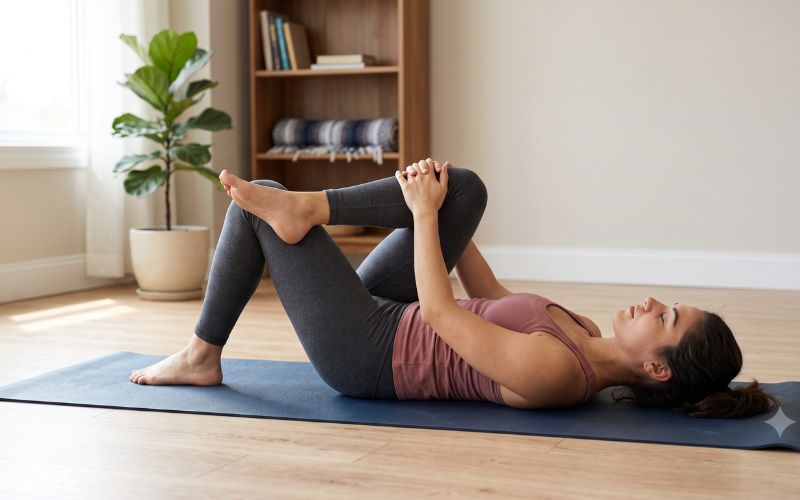
Lying on your back, cross one ankle over the opposite knee and gently pull the standing leg toward your chest. You'll feel this directly in the glute of the crossed leg. One of the most reliable piriformis stretches out there.
Seated Twist
A simple spinal twist, knee crossed over the opposite leg, gently rotating away from it, gives the piriformis a mild stretch while also working through the low back.
Self-Myofascial Release
Sitting on a tennis ball or small foam roller and slowly shifting your weight to find the tender spot in the glute (not the center, slightly off to the side) can help release built-up tension. Go slow. This one can be intense the first few times.
Consistency Over Intensity
This muscle responds better to gentle, regular attention than to one deep, aggressive stretch. Think three or four short sessions a week rather than one heroic effort.
When to See a Doctor About Piriformis Pain
One important note: if you're experiencing real pain, numbness, or tingling down your leg, it's worth getting it looked at by a doctor or physical therapist before assuming it's "just" a tight piriformis. Sciatic pain has more than one possible cause, and it's worth ruling things out.
But for the everyday tightness so many of us carry without noticing, especially if you sit for a living, the piriformis is worth getting to know. It's not as famous as your shoulders or your neck, but it's often doing just as much quiet work.
Next time you're in a hip-opening class at Nova House, pay attention to what's actually happening under the surface. That "ordinary" stretch might be releasing more than you think.